Are You Having the Leave Conversation Backward?
Most organizations manage leave. They track it, comply with it, and ultimately try to shorten it. Far fewer ask the questions that reduce leave in the first place.
Most organizations manage leave. They track it, comply with it, and ultimately try to shorten it. Far fewer ask the questions that reduce leave in the first place.
Most organizations manage leave. They track it, comply with it, and ultimately try to shorten it.
What far fewer organizations do is ask the questions that reduce leave in the first place: what was happening in the weeks and months before that employee filed a request?
That's the conversation I'm bringing to IBI's Philadelphia Regional Seminar on Mental Health Benefits on April 9. It's a conversation meQ has been building toward for years. It's also deeply aligned with my decade of experience in the absence and disability space.
Can't make it to Philadelphia? Read on. This post covers many of the ideas and resources I’ll be sharing.
Picture an employee three weeks into a mental health leave. The acute crisis has passed, they're sleeping again, and for the first time in months, they have space to think.
What they're thinking about is not their return date. They're asking themselves whether the job they left is worth going back to, if their manager will think differently of them, or if their work environment will contribute to continued healing... or wear them down.
Most organizations have nothing to say in that window—no check-in, no signal that the person matters beyond their return-to-work paperwork. And it's the moment that determines everything that comes next.
Mental health leave began climbing in 2020 and has not plateaued. Depression and anxiety alone account for more than 10 billion lost working days globally each year.
Most benefit strategies respond to leave after it happens: coverage, compliance, return-to-work coordination. Those matter, but they do nothing to address behavior change over time, which directly impacts return to work outcomes and future leave.
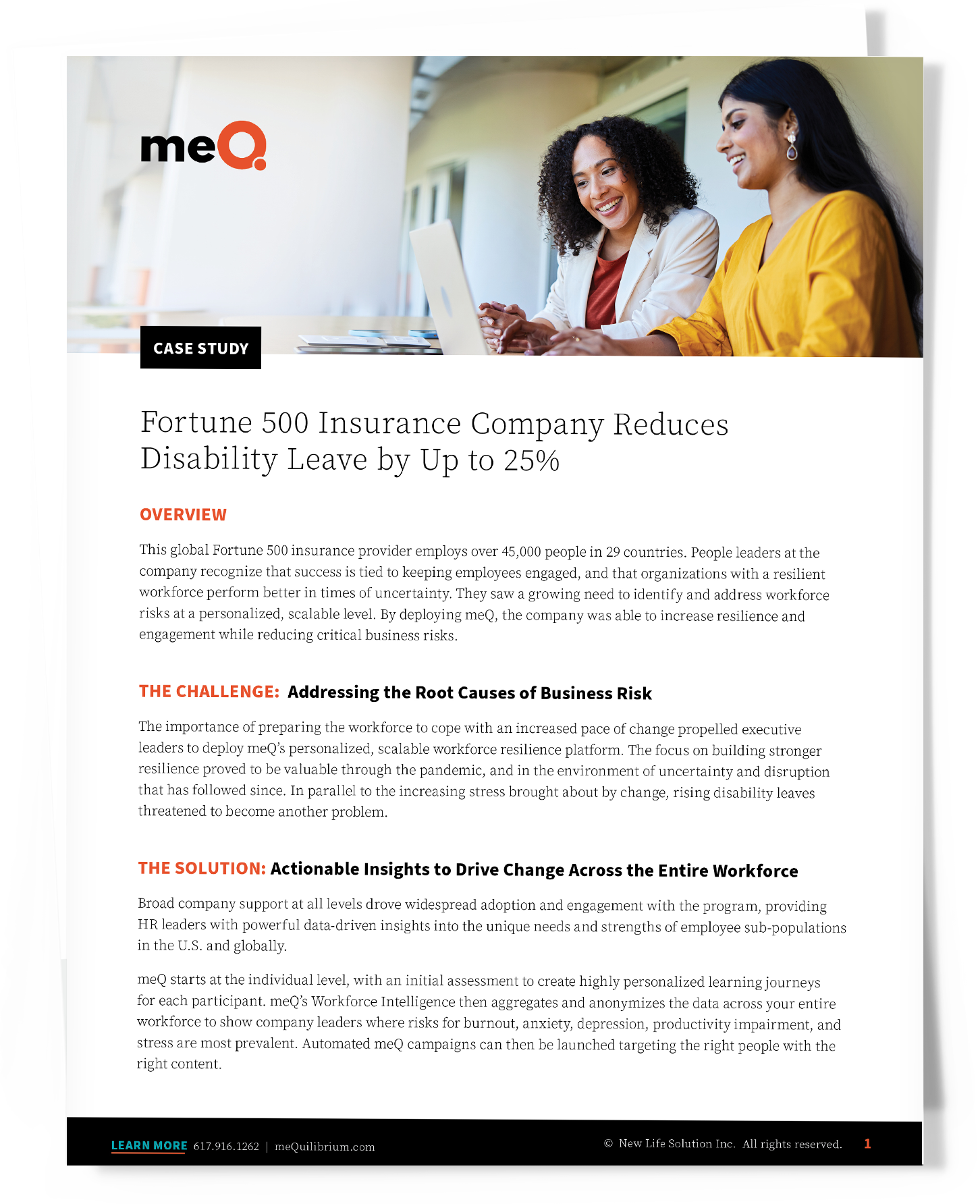 meQ research shows that organizations with more resilient workforces see 25% fewer disability leave events and $500 lower healthcare costs per employee annually. Resilient employees who do take leave return in 25% fewer days, and they come back more engaged, not just recovered.
The same data shows resilient employees experience 40% less absenteeism, are half as likely to plan to quit, and show a third of the presenteeism of their less resilient colleagues. These aren't soft outcomes.
But here is where organizations can get it wrong: they treat these as individual outcomes, not organizational ones. They invest in wellness apps and EAP access and hope employees find their way to them.
They don't ask why certain teams, roles, or functions are burning through people faster than others, or what the data could tell them if they looked.
meQ's workforce intelligence platform surfaces that picture before it becomes a crisis. Using predictive analytics across 18 behavioral and psychological factors, meQ identifies where risk is building — by department, by job function, by manager — and gives organizations the intelligence to act on it.
Not after the leave request. Before it.
That's a fundamentally different conversation than resilience training. It's a conversation about organizational conditions: workload, psychosocial safety, manager quality, meaning and purpose.
The individual resilience piece matters. Helping employees recognize and work through the unconscious beliefs that drive them past their limits is real and valuable. But it's one tool, not the whole toolkit.
The organizations getting ahead of leave are using data to change the conditions, not just the people inside them.
The conversation connecting leave outcomes to employee mental health is a passion of mine, having spent years helping employers scale and humanize their leave processes. One of my core observations: leave isn't just a clinical event.
While employees are out, they're asking whether the organization they're returning to cares about them. The answers to those questions predict whether employees come back at all, and what they look like when they do.
This is where the CHRO and CFO conversation has to happen together. Reducing leave duration by a quarter, lowering disability events, improving return-to-work outcomes: these are shared wins.
IBI's Philadelphia Regional Seminar on April 9 brings together HR professionals, benefits leaders, and business decision-makers focused on mental health claims, benefit utilization, and the real drivers of employee well-being. My 40-minute session is one piece of a broader conversation meQ has been advancing with employers for years.
If you can't make it to Philly, but want to hear more about improving the LOA process, register for the April 28 DMEC webinar, where AbsenceSoft founder Seth Turner and I will discuss 4 Steps to Reducing the Cost and Frequency of Stress-Related LOA. Use code 26MEQUILIBRIUM1 for free registration.