Frontline workers are often your company’s largest population. In most organizations, they're also the least likely to know what mental health benefits they have, or how to use them.
That's not an engagement problem. It's a delivery problem. And when benefits go unused, the costs don't disappear. They show up as burned PTO, deferred leave that becomes longer and more expensive, and presenteeism that never makes it onto a report.
But here's what the data shows: when you actually reach your frontline workers, they engage at the same rate as corporate staff... but improve more.
It’s a clear path to the cost savings your CFO is looking for. Here’s the new frontline benefits map: data on who needs help, proof that it works, and a playbook for reaching them.
The benefits awareness gap hiding in plain sight.
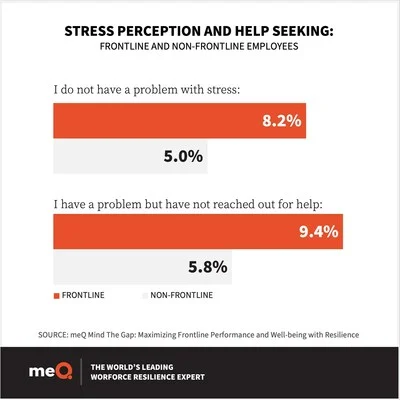
meQ's research found that awareness of mental health benefits is 22% lower among frontline workers than among corporate staff. Among Gen Z, the gap gets worse.
- 73% of non-frontline Gen Z employees feel well-informed about the mental health benefits their employer offers.
- 43% of frontline Gen Z employees say the same.
That is a 30-point gap in a generation that already reports the highest rates of anxiety at work. It is a gap that most benefits dashboards are not built to catch. And it is the first part of the map: the data on who needs help.
Why the gap is so stubborn: stigma.
In the course of our research we asked a frontline worker named Jane, a 38-year old warehouse worker, what she'd do if she needed mental health support at work. Her answer: “I'm a private person. I don't like anyone knowing what I'm going through. I'll use my PTO for leave.”
Jane is not an outlier. meQ's interviews with frontline employees surfaced the same pattern across industries: frontline workers associate mental health benefits with times of crisis, not day-to-day stress. In their minds, it feels like giving up, not getting help.
So they burn vacation instead. They take unpaid days. They push through until they can't.
For a benefits leader, this is not the cost savings it might at first seem. Jane's PTO days are not leave avoided. They are leave deferred, and deferral usually makes the eventual leave longer, more expensive, and more likely to end in attrition. While she's pushing through, she's also not performing at her best. Presenteeism doesn’t show up on a leave report.
Jane is the signal your benefits strategy was supposed to catch, but the one it’s most likely to miss.
Why the gap is so stubborn: structure.
Frontline workers aren’t necessarily disengaged. You’re just not reaching them.
Most benefits strategies were built for employees who sit at desks, check email, and browse intranets. Frontline workers don’t live that reality. Their shifts are irregular, their supervisors are not always trained to recognize stress, and the communication channels that work for corporate staff don’t reach them.
This isn’t an HR failure. It’s a design mismatch: The benefits are real, but the delivery model is not.
That is why awareness data alone doesn’t fix the gap, and why the playbook has to be precise. The gap closes when the design changes.
When frontline workers are reached, they engage and improve more than other workers.
Across meQ's book of business, frontline engagement with digital resilience training is 45% in the first month. Non-frontline engagement is also 45%. Month two: 42% and 43%. Month three: 41% and 42%.
The appetite is the same. The payoff is different.
In a sample of more than 18,000 employees across a full range of industries, frontline populations showed 42% greater improvement in resilience scores than their corporate peers. The population that is hardest to reach is the one that benefits most once it is.
For a benefits leader making the case to a CFO, that’s the argument. Building workforce resilience in your frontline population is the high-return investment most organizations have ignored.
Delivery man pulling hand truck of cardboard boxes at warehouse dock
What it looks like when the business case wins.
One Fortune 50 consumer products company with 320,000 employees (70% frontline) had spent years trying to solve low engagement with its wellness offerings. Live training sessions did not land. Online coursework did not land. The benefits were in place, but the workforce wasn’t using them.
The company partnered with meQ to rebuild their delivery model. Short-form videos, 3-5 minutes each. Relatable messaging that sounded like the workforce instead of just talking at it. Printed materials mailed to employees' homes so the content reached them outside work.
Engagement in a population that had historically been unreachable finally took hold. CHROs gained population-level visibility into frontline risk for the first time. And something unexpected happened: family members who saw the mailers at home encouraged employees to participate, and some started using meQ themselves.
The fix was not more technology. It was meeting people where they were.
How Mental Health Awareness Month can serve frontline workers.
The version of Mental Health Awareness Month that changes the numbers is the one that stops treating frontline mental health as a values question and starts treating it as the cost containment strategy it already is.
That means measuring awareness by cohort, not by average. It means building delivery channels for the whole workforce, not just the ones your intranet was designed for. And it means treating frontline workforce well-being as a measurable business asset.
Close the frontline benefits gap with meQ.
meQ is the workforce intelligence and well-being platform that closes the frontline engagement gap with targeted delivery, resilience training that works, and proof of impact your CFO will recognize.
Talk to meQ to see what a frontline-ready benefits strategy looks like in practice.