A Data-Driven Approach to Reducing Leave of Absence Costs
Organizations that treat leave of absence management as a strategic initiative—not just an administrative task—see measurable gains for their people and their budgets.

Organizations that treat leave of absence management as a strategic initiative—not just an administrative task—see measurable gains for their people and their budgets.
In today’s workplace, organizations are feeling the squeeze from all sides: economic volatility, growing mental health challenges, and rising healthcare costs. Leaves of absence, too, are on the rise; mental health-related leaves of absence have tripled since 2017.
But beneath these pressures lies a powerful solution for mitigating leaves that often gets overlooked—workforce resilience. More than a feel-good buzzword, resilience is a critical lever not just for engagement and productivity, but also for significantly reducing costly outcomes like absenteeism and extended leaves of absence.
When employees are overwhelmed, unsupported, or burned out, the downstream effects can be expensive. Absenteeism and leaves of absence—particularly for stress-related or chronic conditions—can lead to skyrocketing costs and operational disruptions.
Conversely, when people are equipped with the tools to manage stress, bounce back from adversity, and stay mentally fit, the impact is clear: they’re less likely to take time off and more likely to stay engaged.
Two case studies below offer compelling evidence for this connection.
Paychex, a leading provider of HR and payroll solutions, partnered with meQ to deepen its employee well-being strategy. Leveraging third party analytics experts from their data warehouse vendor, Paychex discovered that employees who participated in meQ’s resilience-building programs were less likely to take extended leaves of absence than their peers.
As Marcy Hotchkiss, Manager of Employee Well-being Programs at Paychex, shared, “One other piece that was really exciting for Paychex was, we were able to connect to our extended leave of absence data. We were able to determine through our data warehouse that the rate of employees taking continuous leave is significantly lower among employees who participate in meQ.”
This finding builds on Paychex’s broader efforts to connect resilience to business outcomes. In a previous study, the company found that employees who completed meQ resilience training were 18% less likely to quit than matched peers. The message is clear: resilient employees are not only more likely to stay—they’re more likely to stay well.
Read the full case study here.

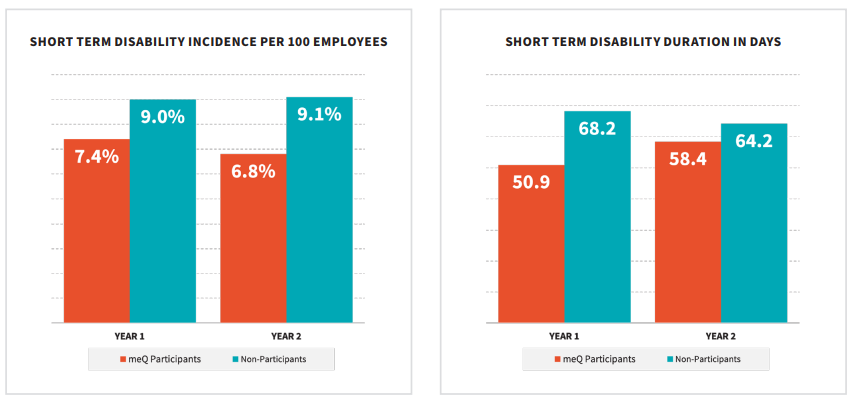
A Fortune 500 insurance provider deployed meQ across its global workforce of over 45,000 people to identify and mitigate workforce risks, including rising disability claims.
The results:
These outcomes weren’t just anecdotal. A third-party, causal analysis using matched employee samples (accounting for age, gender, job type, mental health history, and more) validated the findings. The improvements were seen across both mental health and physical health disability leaves—highlighting the holistic power of resilience to influence overall well-being.
Read the full case study here.
The healthcare costs tied to absenteeism and disability leaves are massive. When employees go out on extended leave, it creates not only direct costs (e.g., wage replacement) but also indirect ones—lost productivity, disrupted teams, and hiring temporary workers).
Workforce resilience offers a scalable, proven path forward. By helping employees proactively manage stress, improve coping skills, and strengthen mental fitness, companies can see real savings—and real gains in performance and retention.
Most organizations focus on managing leaves of absence—but fewer have a plan to help employees return. Companies that support employees with thoughtful re-onboarding and resilience strategies reap the rewards—shorter leave durations, lower costs, and more engaged teams.
Join us December 10, 1–2 pm ET for our webinar, Resilience That Pays Off: Helping Employees Return Stronger, Sooner, to see real examples from organizations that are getting this right.

meQ identifies, addresses, and measures the root cause of risks to workforce performance at an individual and organizational level, delivering personalized solutions at global scale.