Top Performing Employees Have Better Boundaries, Not Fewer
What meQ’s 2026 State of the Workforce Report reveals about grind culture, sustainable performance, and what’s driving your retention risk.
What meQ’s 2026 State of the Workforce Report reveals about grind culture, sustainable performance, and what’s driving your retention risk.
Your workforce is sending you a signal that can be measured, but is often missed—in the headaches, the sleep disruption, the 7 a.m. emails that feel more like survival than ambition. It’s all about the grind.
meQ surveyed 2,620 employees to understand grind culture: who believes in it, what it costs, and what drives high performance when you strip the hustle mythology away. This blog covers the four findings that matter most for HR and benefits leaders—including the one that reframes the entire conversation about performance investment.
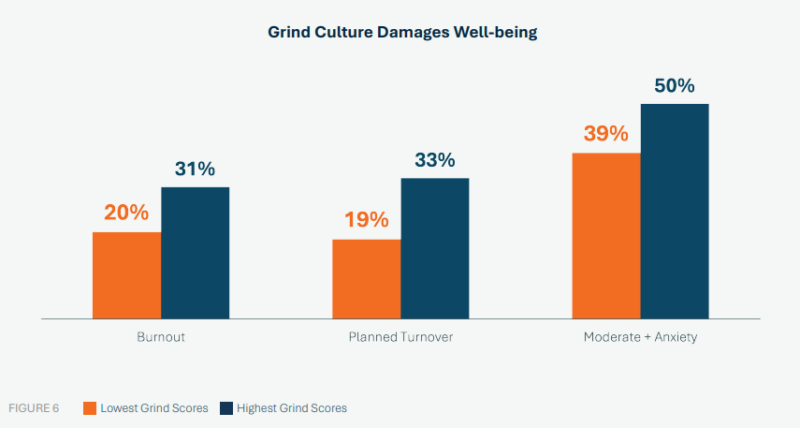
More than half of workers surveyed believe that failing to constantly improve means falling behind. Most reject grind culture’s extremes—only 11% equate exhaustion with productivity—but the sustained pressure to perpetually perform is doing measurable damage.
Employees who most strongly embrace grind culture beliefs show worse outcomes across every metric that matters to your organization:
These aren’t engagement scores. They’re leading indicators of the turnover, absenteeism, and healthcare costs that show up in your CFO’s quarterly review.
Resilience functions as a filter. It removes the toxic beliefs about work—that success requires sacrifice, that rest is weakness—while amplifying the healthy ones. Resilient employees are more convinced that effort leads to reward.
Over 12 months, the most resilient employees outpaced their least resilient peers across every well-being indicator:
Resilience doesn’t just prevent decline. It accelerates recovery—and that difference compounds over time.
Employees with strongly supportive managers are less likely to believe success requires sacrificing relationships. The mechanism is channeling, not softening—strong managerial support redirects ambition toward sustainable output rather than letting it consume everything around it.
For HR leaders building the internal case for manager development investment, this is the framing that lands with finance: supported employees don’t work less. They work harder, because their hard work is acknowledged.

Remote and hybrid employees are 28% less likely than on-site workers to believe their effort leads to visible results. This compounds findings from meQ’s Summer 2025 report, which showed remote workers carry higher work uncertainty stress, and the two are almost certainly connected.
When you can’t read the room, you can’t tell if what you’re doing is registering, which eventually erodes the motivation to sustain it. For distributed teams, structured recognition and manager visibility aren’t culture perks. They’re performance infrastructure.
The strategic choice is clearer than it’s ever been: continue extracting performance through pressure, or invest in building the conditions that make effort feel worthwhile. One compounds over time. The other does too, but in the wrong direction.
High performance doesn’t have to be a grind. That’s not a tagline. It’s what employees across every industry are saying out loud.
 Download the 2026 State of the Workforce Report for the complete report, including a practical strategy framework to bring to your next leadership conversation.